
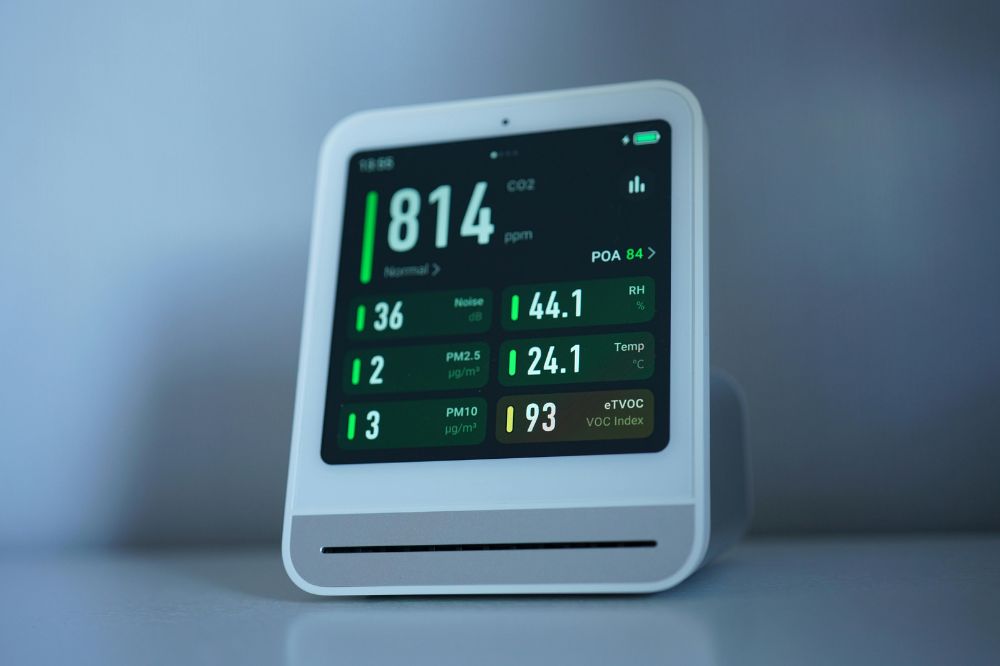

The little air monitor on your shelf glows green most of the day. Then you sear a steak or spray a bathroom cleaner, and it jumps to orange.
Most of those swings mean something. Some numbers on the screen deserve more attention than others, and a few problems never show up on the screen at all.
Indoor air is worth watching. The EPA reports that Americans spend about 90 percent of their time indoors, where some pollutants are often two to five times higher than outdoors.
What these monitors are built to do
Most consumer monitors sense gases or particles. The usual lineup is fine particles (PM2.5), carbon dioxide, volatile organic compounds (VOCs), temperature, and humidity.
The EPA is careful about what that adds up to. Its guidance on low-cost air pollution monitors and indoor air quality says these devices don’t give a complete picture of indoor air quality.
The same guidance says there’s limited information on how accurate they are. Most were evaluated in outdoor conditions, which may not match how they perform in a living room.
The levels that turn a reading yellow or red are chosen by each device’s manufacturer. Treat the colors as a prompt to look closer.
What a consumer monitor won’t catch
Radon
The EPA points out that a monitor built for particles wouldn’t alert you to radon. Radon needs its own test, and a radon test is the only way to know your level.
Carbon monoxide
The EPA also notes that consumer monitor alerts aren’t designed to warn of immediate danger to your health or life. Keep a dedicated carbon monoxide alarm, whatever your air monitor shows.
Mold
Monitors read gases and particles in the air around them. They can’t tell you whether mold is growing behind a wall or under a floor.
The EPA’s caveat runs the other way too. A detected pollutant doesn’t necessarily mean there’s an air quality problem, and readings don’t translate directly into health outcomes.
Where a monitor stops and a professional test starts
A monitor tells you that something changed. It usually can’t tell you why, or where it’s coming from.
A professional assessment fills that gap by pairing measurements with an investigation of the house itself. When a question needs a specific answer, samples go to a lab.
Barry Westbrook, a Senior Certified Industrial Hygienist who founded DocAir in 2002, built the firm around a “science before sales” rule. Diagnose the cause first, and recommend only what the evidence supports.
In practice, his firm leaves a monitoring device in the home to log conditions over time and sends air samples to a certified lab, with the aim of pinpointing the source.
That kind of testing makes sense when readings stay high, and you can’t find the source. The same goes for a musty smell that won’t go away, or symptoms that ease when you leave the house.
Reading the numbers your monitor does give you
Fine particles
PM2.5 sensors are best at showing change. The EPA suggests comparing levels before, during, and after an activity like cooking.
If the number climbs when the stove is on and falls after the range hood runs, the monitor is doing its job.
The reading worth chasing stays high when nothing is going on.
Carbon dioxide
CO2 is a ventilation clue. ASHRAE, the engineering society that writes the 62.1 and 62.2 ventilation standards, says indoor CO2 doesn’t provide an overall indication of air quality.
It still has a use. ASHRAE notes that CO2 readings far above the expected range likely mean ventilation isn’t working properly.
If CO2 builds up every night in one bedroom, ask how much fresh air that room actually gets.
ASHRAE’s ventilation standards don’t set CO2 limits based on health, so your monitor’s red zone for CO2 is the manufacturer’s call.
VOCs
The VOC reading on most monitors is a single total. It rolls many different chemicals into one number.
That makes it hard to interpret. A presentation hosted by the EPA made the point that a total VOC reading can’t tell baking cookies apart from painting your nails.
Use VOC spikes to connect readings to activities, such as cleaning day or fresh paint. The number alone won’t name the chemical.
Humidity
For many homes, humidity is the most useful number on the screen. The EPA advises keeping indoor humidity below 60 percent, ideally between 30 and 50.
The EPA also says moisture control is the way to control mold. In a humid summer, a monitor that keeps reading in the 60s is worth paying attention to.


