
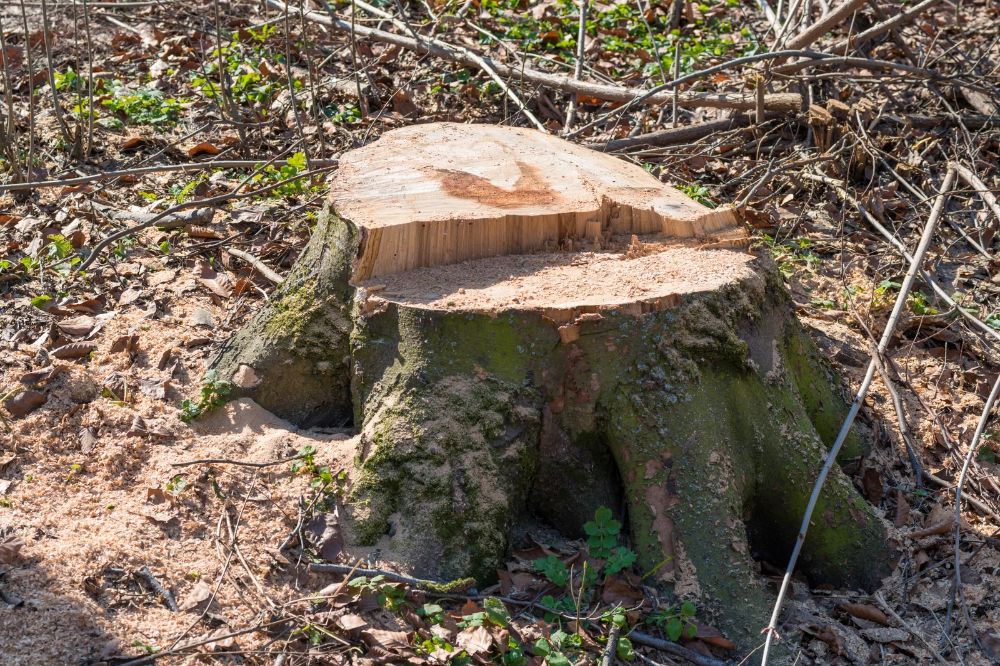

Once the tree is down and the crew has packed up, the stump looks finished. Below the surface, a lot is still going on.
The roots are still in the soil, and many of them still hold the food the tree stored. Decay has barely started.
What happens next depends on the kind of tree and what you decide to do with the spot.
The First Season, When Some Stumps Push Back
A cut stump isn’t always dead. If the tree was alive when it came down, it may send up new shoots from the stump or from the roots around it.
Those shoots grow from dormant buds near the root collar, where the trunk meets the roots. The food stored in the roots before the cut is what fuels them.
Which Stumps Are Likely to Sprout
Broadleaf trees are the usual sprouters. Penn State Extension notes that all of them are believed to have the ability, while conifers rarely do.
Oaks and maples are among the most vigorous stump sprouters. Aspens and black locust can also push up shoots from their roots.
Most pines, spruces and firs won’t come back once they’re cut. Pitch pine is one exception, though its ability fades as the tree ages.
If sprouts appear, cutting them off while they’re small slowly drains what’s left in the roots. Expect it to take years of trimming before the stump gives up.
The crew at Mike’s Professional Tree Service, a Rhode Island tree company that handles tree removal and stump grinding, put this guide together.
The Long Middle, When Decay Takes Over
If the stump doesn’t sprout, it slowly rots in place along with its roots. Wood-decay fungi do most of that work.
How long it takes depends on the species, the size of the stump, soil moisture and how many decay fungi are present. Natural decay can run 10 years or more.
Mushrooms popping up on the stump or over old roots are usually a sign the wood is breaking down.
Who Moves In as the Wood Softens
A rotting stump is habitat. Dead stumps feed and shelter insects, birds and other wildlife, which is a plus in a natural corner of the yard.
Near the house, that same habitat is less welcome. Carpenter ants nest in moist, decaying wood, including old stumps and roots.
Termites are the other concern. The University of Kentucky’s termite guidance advises removing stumps and dead roots around and beneath buildings where practical.
When a Stump Affects Nearby Trees
Some root-rot fungi live on in old stumps. Armillaria, known for clusters of honey-brown mushrooms in fall, survives in dead roots and stumps.
Penn State Extension notes it can spread through the soil in shoestring-like strands that grow several feet from a stump to nearby trees.
If the tree you lost died of root rot, that’s a good reason to remove the stump and large roots. Ask before planting another tree in the same spot, too.
Speeding Things Up
Grinding is the fastest route. A grinder chews the stump and big surface roots into chips, from just below the surface to a foot or more deep.
Most companies price grinding by the size of the stump, measured at its widest point. Deeper grinding usually costs more and leaves a bigger hole.
The chips change the soil and make it hard for new grass to grow. If you want lawn there, have the chips hauled off and the hole filled with topsoil.
Roots beyond the grind stay in the ground and keep breaking down on their own.
Digging works for small stumps. It’s hard labor but quick, while digging or pulling a large stump isn’t practical.
If you’d rather wait it out, drilling holes speeds up decay by giving fungi more wood to work on.
Iowa State University Extension’s guide to removing tree stumps suggests one-inch holes, at least 10 inches deep and no more than a foot apart.
After one to three years, the stump can usually be broken up with a sharp spade.
Skip burning. Stump fires can smolder for days and are hard to put out.
Herbicide applied right after the cut can reduce sprouting, but it won’t speed decay.
Leaving It Can Work Too
In a wooded corner or a garden bed, a stump can serve as a decorative piece or a wildlife spot for years.
Check on it now and then. Once decay makes it soft or unstable, it’s time to take it out.
Questions to Settle Before You Decide
- Is the stump close to the house, a deck or a walkway?
- Did the tree have a disease, especially root rot?
- Is it sending up sprouts?
- Do you want lawn, a garden bed or a new tree in that spot?
- Can you wait a few years, or do you need the space this season?
Your answers usually point to one of three paths. Grind it, help it rot, or leave it and keep an eye on it.
