
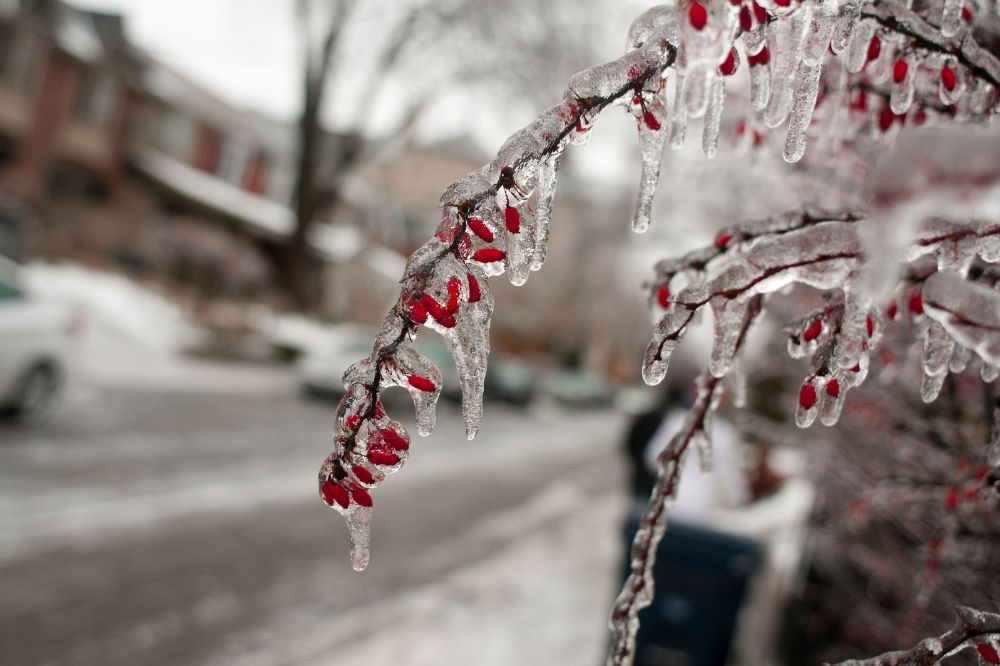

An ice storm looks worst while it’s happening. Trees are bent over, power lines are down, and every surface has a glaze of ice on it.
The damage that costs homeowners the most often shows up later. It shows up as a faint ceiling stain, a musty smell in a closet, or paint that bubbles on a wall near the eaves.
Here’s where that damage starts, why it stays hidden, and what to check once the ice melts.
How freezing rain works on a roof
Snow sits on a roof. Freezing rain coats it. The rain freezes when it hits a cold surface, so it bonds to shingles, flashing, gutters and vents as a solid shell.
The National Weather Service treats a quarter inch of ice as a significant accumulation. That much radial ice is enough to snap branches and bring down power lines, and it takes even less when the wind picks up.
That’s why the damage to roofs and the damage to trees usually happen together.
Five ways ice damages a home without showing it
Falling limbs crack the roof deck
A heavy limb doesn’t have to come through the roof to do harm. It can crack the decking underneath or split a shingle seal, and from the ground the roof still looks fine.
The leak starts at the next rain, when water runs into the crack and soaks into the plywood.
Meltwater refreezes at the eaves
When the sun comes out or temperatures rise, ice on the upper roof melts first. The water runs down to the colder edge, where it freezes again and builds a ridge.
Water then pools behind that ridge and works its way under the shingles. University of Minnesota Extension says this water can get into the attic and from there into exterior walls or through the ceiling insulation.
Gutters pull away under the weight
Gutters packed with ice get very heavy. They can bend, pull loose from the fascia board or open gaps where the roof meets the wall.
Once that seam opens, rain runs behind the gutter instead of into it, straight into the wall cavity.
Attic pipes freeze during power outages
Long outages are common after a major ice storm. Without heat, water lines that run through attics or along exterior walls can freeze and split.
The pipe leaks once it thaws. Since it’s above the ceiling, nobody sees it until the drywall sags or a stain appears.
Wet insulation holds water out of sight
Fiberglass and cellulose insulation soak up water and hold it against the drywall below. The ceiling can look dry from inside the room while the back side stays wet for days.
That trapped moisture is exactly what mold needs.
Why the stain shows up weeks later
Water rarely drips straight down. It runs along rafters, tracks across the top of the drywall and settles at the lowest point, sometimes a full room away from the actual roof leak.
InterNACHI notes that water from ice-related leaks can get into wall cavities and make paint peel and blister. That can happen long after the ice is gone, so the damage doesn’t look connected to the storm.
By then the drywall has been wet for days or weeks, and that’s when a simple drying job becomes a much bigger repair.
What southeast Oklahoma homeowners have learned
Oklahoma knows ice storms better than most states. The Oklahoma Climatological Survey has recorded ice four to five inches thick across the southeast during the January 2007 storm.
The same storm put all 77 Oklahoma counties under a federal emergency declaration. McAlester had been hit hard by an ice storm in December 2000 before that one.
Damon Thompson, owner of FloodSERV in McAlester, says the calls rarely come during the storm itself. “People call us two or three weeks later about a ceiling stain they can’t explain. By the time we trace it back, the insulation has been wet since the thaw. Getting ahead of that is the whole point of professional water damage restoration after a storm.”
What to check after the ice melts
Give the roof a few days to clear, then walk the house with a flashlight. Look for these:
- Brown rings or yellow stains on ceilings, especially near exterior walls
- Sagging or soft spots in drywall
- Peeling or bubbling paint high on walls near the eaves
- Damp or flattened insulation in the attic
- Daylight through the roof boards when you look up from the attic
- Gutters that sit crooked or have pulled away from the fascia
- A musty smell in upstairs closets or rooms under the roof
Outside, look for dented flashing, missing shingle tabs and broken limbs still lying on the roof.
Why the 48-hour window matters
The EPA says water-damaged areas and items should be dried within 24 to 48 hours to prevent mold growth. Hidden leaks blow past that window because nobody knows they’re there.
University of Minnesota Extension also warns against repairing ceilings and walls until they’re fully dry. Paint over a damp ceiling and the stain comes back, and anything growing underneath keeps spreading.
If the drywall has been wet for longer than that, it’s worth getting a professional opinion on mold removal from water-damaged ceilings and walls before you start patching.
Don’t wait for the next rain
An ice storm can do its damage in one night and then hide it for weeks. A slow walk-through after the thaw takes less than an hour and catches most of the problems listed above.
If you find a stain, a soft spot or wet insulation, deal with it now. The longer water sits in a ceiling, the more of that ceiling has to come out.
12) cwgmagazine.com
What You Need to Know
- Ice accumulation can cause damage to roofs, trees, and power lines, with a quarter inch considered significant by the National Weather Service.
- Falling limbs can crack roof decking or split shingles, leading to leaks that may not be visible until the next rain.
- Meltwater can refreeze at the eaves, creating a dam that allows water to pool and potentially enter attics or walls.
- Frozen attic pipes can burst after thawing, causing hidden leaks and subsequent damage to drywall and insulation.
- Wet insulation can conceal moisture against drywall for days, creating conditions conducive to mold growth.
- Effective damage assessment after an ice storm should occur within 48 hours to prevent mold and further structural issues.
